

Fragile items can break on a short city move even when every box is well packed. The problem often appears along the route: tight hallways, elevator waits, curbside loading, and stop-and-go driving.
A practical route plan connects packing to the actual path your items will travel. It helps show where boxes may be tilted, paused, handed off, or loaded under pressure, so fragile pieces move with more control.
Map the risk points before the first box moves
Before a fragile box leaves the apartment, the route can create as much risk as the packing. In a city move, breakables may pass through narrow halls, elevator thresholds, stair turns, shared lobbies, curbs, and short loading zones. Each point affects how a box is carried, paused, set down, or handed off.

A route map does not need to be formal. It can be a quick mental or visual check of where impact, tilting, crowding, or rushed handling is most likely. A tight doorway may matter for picture frames. An elevator gap may matter for glassware. A crowded curb can expose fragile boxes to stacking pressure.
The key difference is packed protection versus route protection. Packing paper, bubble wrap, dividers, and cushioned boxes reduce movement inside the box. Route protection manages what happens outside it: the carry path, handoff timing, pause surfaces, and loading order. If you are also coordinating building logistics, a simple apartment move checklist can help keep timing, access, and small details from competing with careful handling.
Common city risk points include:
- narrow turns where boxes can brush walls or door frames;
- elevator entrances where thresholds interrupt smooth movement;
- stair landings where items may be paused or repositioned;
- lobby areas where building traffic can create delays;
- curbs and vehicle edges where walking pace shifts to loading pace.
Labels help, but they have limits. A “fragile” mark signals priority, not the difficult corner or awkward elevator approach. When those points are visible before lifting begins, fragile boxes can be staged, carried, paused, and loaded with more control. For route-heavy apartment or neighborhood moves, working with local movers can also make it easier to plan access points, staging, and loading order around the actual city path.
Keep every handoff controlled, from elevator to truck
The most fragile moment in a city move is often not the truck ride. It is the short transfer between controlled spaces: elevator to lobby, lobby to doorway, doorway to curb, and curb to truck. Each handoff changes the surface, light, available space, and person responsible for the item.
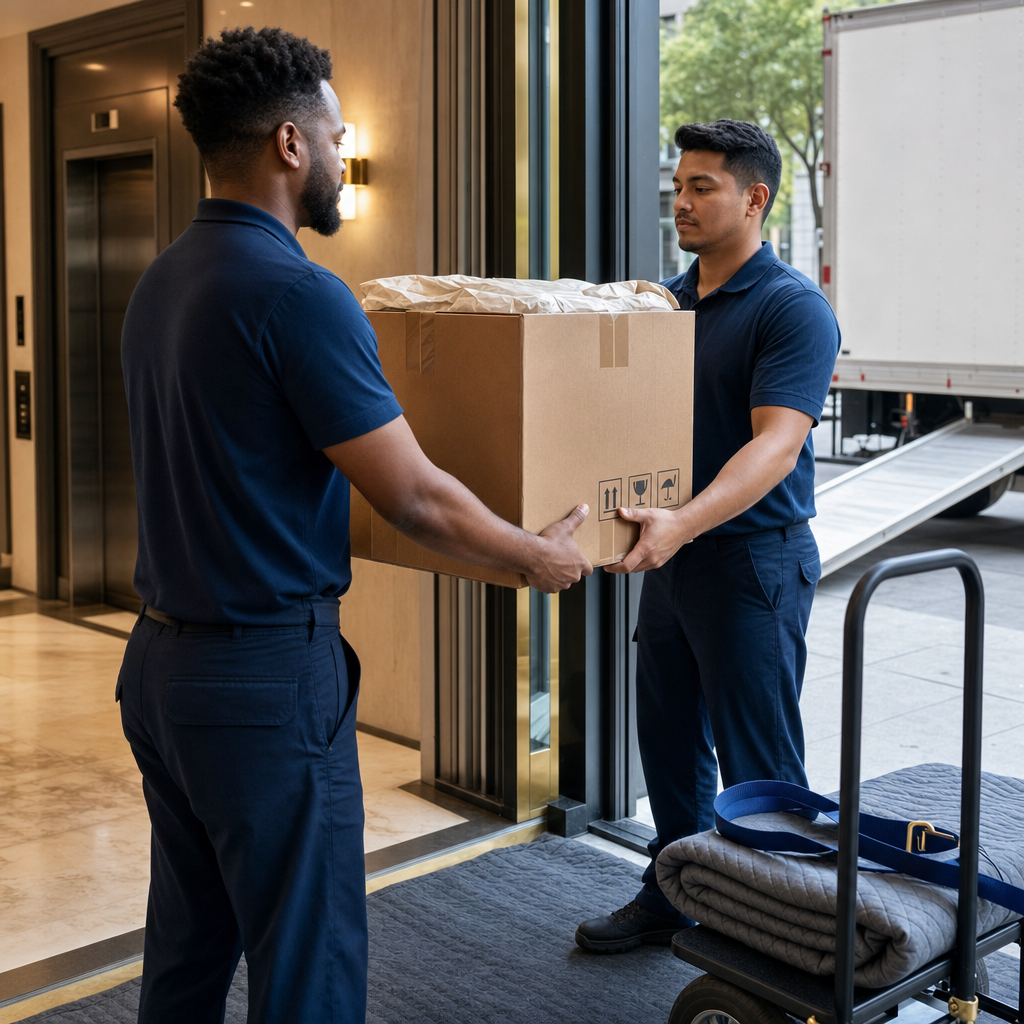
A wrapped box can still face impact if the transfer is rushed. Risk rises near elevator thresholds, glass doors, curb edges, ramps, and tight loading zones. Small changes in height or direction can shift the box or force a weaker grip.
Stable handoffs rely on three simple controls:
- The item stays close to the body, not extended at arm’s length.
- The receiving person has both hands ready before weight changes sides.
- The transfer stays short, with a clear place to set the item if movement pauses.
This matters because fragile protection works like a chain. Packing materials reduce movement inside the box. Handoff control reduces sudden movement outside it. If one part is missing, the move path has a weak point.
Clear communication helps in shared city spaces. A label identifies a fragile box, but it cannot manage timing at a doorway or truck ramp. A brief verbal cue during transfer helps both people know when weight is moving and when the box is secure.
The useful signal is not speed. It is a clean transfer: no twisting, no dropped corner, no blocked doorway, and no box placed where heavier items can press against it.
Fragile-item protection works best as a system. Packing reduces impact inside the box; route control reduces bumps, drops, and rushed handoffs outside it.
A calm move plan looks at both. If the path includes stairs, elevators, or tight curb timing, those spots become useful checkpoints for staging, carrying, and loading fragile boxes.
Smart People Moving supports local residential and apartment moves with careful handling, organized loading, and route-aware moving practices. If you are planning a city move with fragile items, these route points can work as a starting checklist before you request a quote for a careful local move plan.